
Why Your Leads Are Low Quality (And How to Get Better Leads)
Tired of enquiries that go nowhere? Find out why your leads are low quality and the specific changes you can make to attract better, more qualified leads for your business.
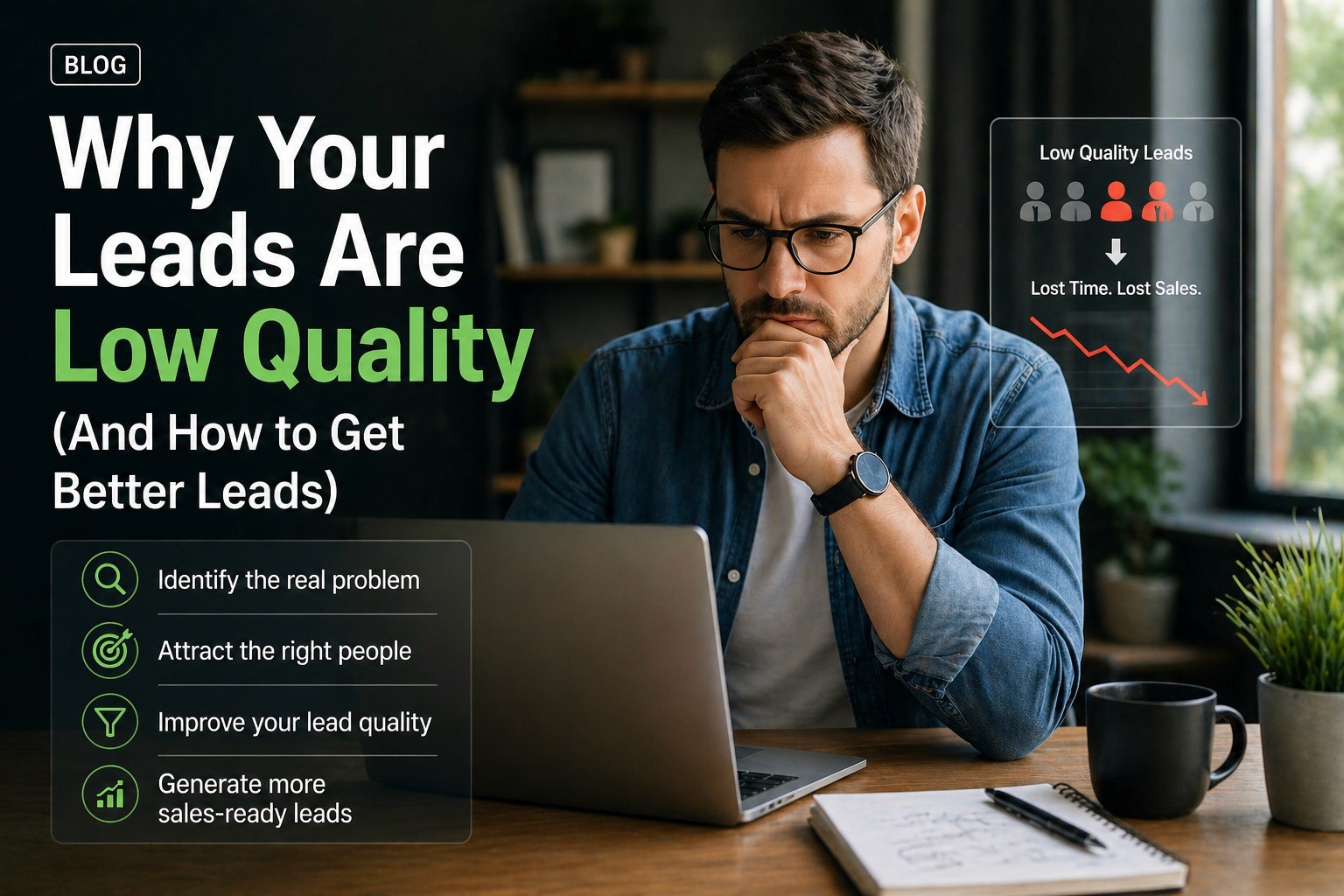
Getting leads is one thing. Getting leads that actually turn into customers is another matter entirely. If your enquiry inbox is full of people who ghost you after the first message, argue over price, aren't ready to buy, or simply aren't the right fit — you're not alone. Low-quality leads are one of the most frustrating problems in small business marketing.
The good news is that lead quality isn't random. It's almost always a reflection of something specific in your marketing — and once you identify what that is, it's fixable. This guide breaks down the most common reasons leads go bad and, more importantly, what to do about it.
What Do We Mean by 'Low-Quality Leads'?
Before diagnosing the problem, it's worth being precise about what low-quality actually means. A low-quality lead might be someone who:
Enquires but never responds to follow-up
Is only interested in the cheapest possible option
Isn't actually ready to buy yet
Doesn't have the budget for what you offer
Has completely unrealistic expectations
Isn't located in your service area
Needs something you don't provide
All of these are different problems, but most share a common root cause: your marketing is attracting the wrong people, or failing to filter out the wrong people before they make contact.
Reason 1: Your Targeting Is Too Broad
This is the most common cause of low-quality leads, particularly for businesses running paid advertising. When you cast too wide a net — targeting everyone in a large geographic area, or using broad keyword phrases — you inevitably attract people who aren't a good fit.
The fix: narrow your targeting. If you're running Google Ads, use more specific, intent-rich keywords (e.g. 'emergency plumber Manchester' rather than 'plumber'). If you're on social media, spend more time defining your audience by age, income, interests, and behaviour. If you're relying on organic search, create content that speaks specifically to your ideal customer rather than trying to appeal to everyone.
Fewer leads from a tighter audience will almost always outperform high volumes from a broad one.
Reason 2: Your Messaging Doesn't Qualify People
Your marketing copy — your website, ads, social media posts, or listings — should act as a filter, not just a magnet. If your messaging is vague or generic, it attracts vague, generic enquiries.
Strong qualifying messaging does things like:
Clearly stating who you work with (and who you don't)
Being upfront about price ranges or minimum project values
Describing the types of problems you solve with specificity
Using language and examples that resonate with your ideal customer
If someone reads your website and thinks 'that's exactly me' — they're going to be a better lead than someone who reads it and thinks 'I suppose this might work.'
Don't be afraid to put off the wrong people. Every enquiry that wasn't going to convert anyway costs you time.
Reason 3: You're Visible in the Wrong Places
Where you market matters as much as how you market. If your ideal customer is a 45-year-old business owner, but all your marketing effort goes into TikTok, you'll generate a lot of activity that doesn't convert. If your ideal customer is a local homeowner, but you're targeting national keywords in your SEO, you'll attract visitors with no intention of hiring you.
Map where your ideal customers actually spend their time and search for services like yours, then concentrate your efforts there. For most local service businesses, this means Google Search, Google Maps, and word-of-mouth referrals. For B2B businesses, it might mean LinkedIn and industry-specific directories. For e-commerce, it might be Meta ads and Google Shopping.
Being on the right platform is more important than being on every platform.
Reason 4: Your Offer Isn't Positioned for the Right Buyer
If you want premium clients, you need to position yourself as a premium provider. Businesses that compete primarily on price attract price-sensitive buyers. If your marketing leads with 'affordable,' 'cheap,' or 'budget-friendly,' you'll consistently attract buyers for whom price is the primary driver — and those buyers are rarely loyal, rarely easy to work with, and rarely worth having.
To attract better-quality buyers:
Lead with outcomes and results, not price
Showcase credentials, qualifications, and experience
Use case studies and testimonials that demonstrate quality
Position your service as an investment, not a cost
You don't have to be the most expensive option in your market — but you do need to give buyers a reason to choose you other than being the cheapest.
Reason 5: Your Enquiry Process Has No Qualifying Step
Some businesses make it too easy to get in touch — in a way that actually creates problems. A simple contact form with just a name and email asks so little of the person filling it in that it attracts highly speculative enquiries. Adding a few qualifying questions to your enquiry form can transform the quality of what you receive.
Consider asking:
What is the approximate budget for this project?
What's your timeline for getting started?
Briefly describe what you're looking for
Where are you based?
Someone who is genuinely ready and serious will take two minutes to answer these. Someone who's kicking tyres probably won't bother — which is exactly what you want.
Reason 6: You're Not Defining 'Quality' Clearly Enough
It's surprisingly common for business owners to feel that their leads are low quality without having clearly defined what a good lead looks like. Before you can consistently attract better leads, you need a clear picture of your ideal customer:
What industry are they in, or what type of property do they have?
What's their typical budget?
What problem are they trying to solve, and how urgently?
Where do they look when searching for a business like yours?
What would make them choose you over a competitor?
Once you have that profile, everything in your marketing should be calibrated to attract that person and filter out everyone else.
How to Systematically Improve Lead Quality
Improving lead quality isn't a one-step fix — it's the result of calibrating multiple parts of your marketing in the same direction. Here's where to start:
Audit your current leads: look at your last 20–30 enquiries and identify patterns. Where are the bad leads coming from? What do they have in common?
Review your messaging: does your website speak directly to your ideal customer, or is it written for everyone?
Tighten your targeting: are you advertising in the right places, to the right people, with the right keywords?
Add qualifying questions to your enquiry form
Build case studies that attract the type of customer you want more of
If you're getting leads but struggling to convert them into paying customers, that's a slightly different problem — and one we cover in detail here:
→ Read: Why You're Getting Leads But No Customers (And How to Fix It)
And if you want to build a marketing system that generates consistently better leads from the ground up, we'd love to talk.
→ Read: Small Business Marketing System — How to Get More Customers Consistently